

Science-Backed: Supported by Human Clinical Trials
Our pomegranate seed oil is at the forefront of scientific research. Its efficacy has been rigorously tested and validated through a series of clinical studies published in leading international medical journals. We are committed to the highest standards of transparency and scientific integrity, and we encourage you to explore the full findings
This study was published in the prestigious international journal Biology and is indexed in PubMed, the official database of the U.S. National Library of Medicine.
The following summary of the research data has been generated and adapted with the assistance of artificial intelligence (AI) for easier public comprehension. This material is provided strictly for informational purposes. For complete and accurate scientific data, please refer to the original published study.


Did you find this content helpful? We would really appreciate it if you shared it!
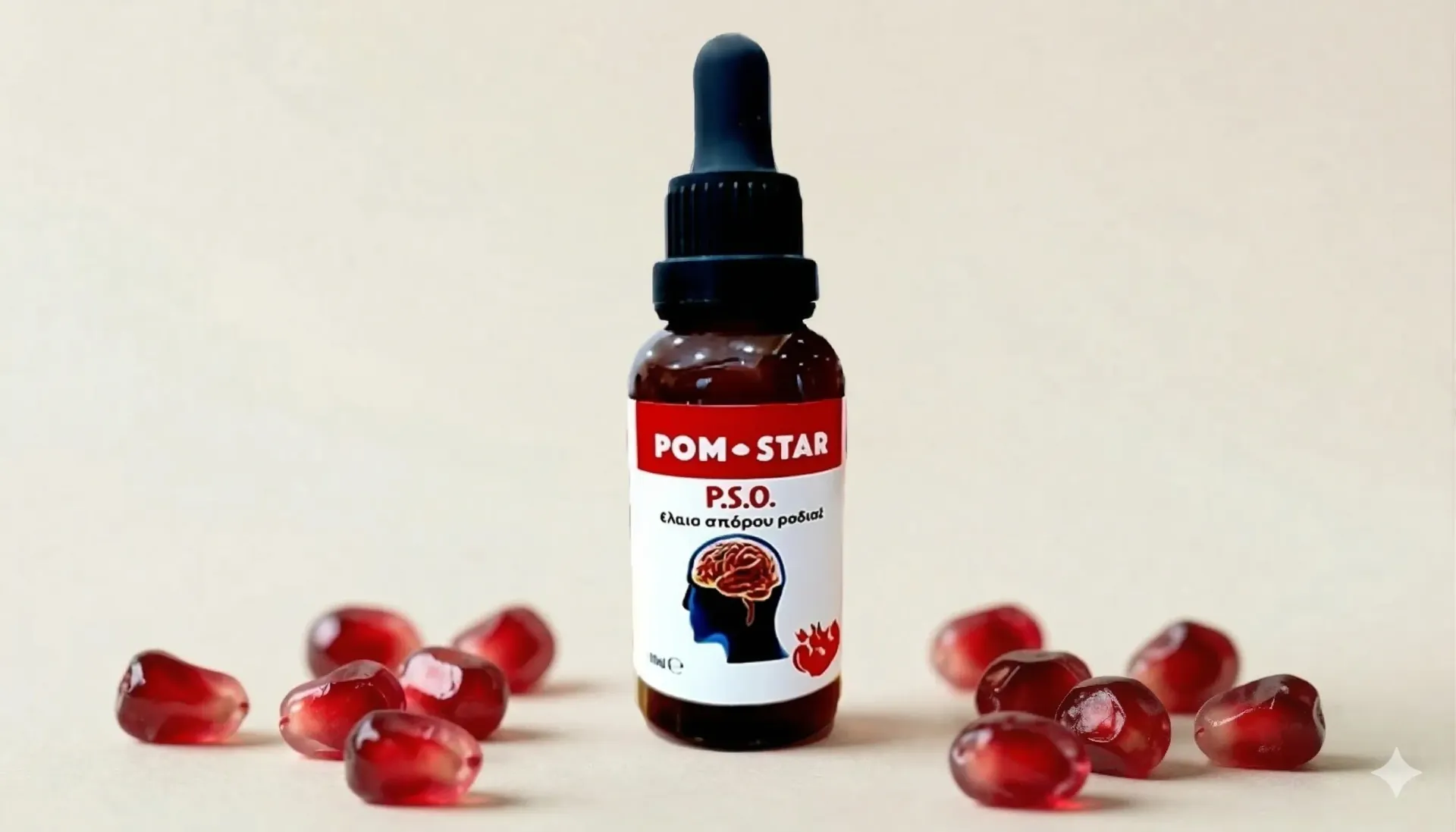
Pom-Star Pomegranate Seed Oil & Cognition: 1-Year Clinical Study
The following summary of the research data has been generated and adapted with the assistance of artificial intelligence (AI) for easier public comprehension. This material is provided strictly for informational purposes. For complete and accurate scientific data, please refer to the original published study.
Το αρχείο που ακολουθεί δημιουργήθηκε, επεξεργάστηκε και συμπυκνώθηκε με τη βοήθεια τεχνητής νοημοσύνης (AI), με τη χρήση ερευνητικών δεδομένων. Οι πληροφορίες ενδέχεται να παρουσιάζουν μικρές αποκλίσεις σε σύγκριση με το πρωτότυπο.
By •21 Ιουλίου 2026
Pomegranate Seed Oil and Cognitive Function: What a One-Year Human Clinical Study Found

In short: In clinical research conducted in Greece with adults experiencing Mild Cognitive Impairment (MCI), a daily intake of 5 drops of cold-pressed pomegranate seed oil (Pom Star / Rodi Hellas), alongside the Mediterranean Diet, over 12 months, was associated with statistically significant improvements in global cognition, verbal episodic memory, processing speed and executive function — as well as favourable shifts in key cellular biomarkers of healthy brain ageing. The active compound: punicic acid (Omega-5), at 70%–85% of the oil's composition.
What was actually studied
Two things set this body of research apart. It was conducted in humans, not only in a laboratory — and it examined this specific oil, not a generic pomegranate extract.
ParameterDetailPopulationAdults with Mild Cognitive Impairment (MCI)ProductGreek pomegranate seed oil, cold-pressed, 100% pure, no additives (Rodi Hellas / Pom Star, organic cert. GR-BIO-02)Dosage5 drops dailyDuration12 months, supervisedControl groupMediterranean Diet only, without the oilInstitutionsAristotle University of Thessaloniki and the Greek Association of Alzheimer's Disease and Related Disorders
Participants underwent comprehensive neuropsychological assessment before the study period began and again at its conclusion, while biological markers were measured in blood serum in parallel.
What the results showed
1. Everyday cognitive performance
The group taking the oil performed significantly better than the control group across three domains:
- Global cognition — MMSE scores improved from 27.65 to 28.45 (p=0.0046), with a significant advantage over controls at the 12-month mark (p=0.0015).
- Verbal episodic memory — the ability to take in new information and recall it later.
- Processing speed and executive function — planning, organising, and switching between tasks.
2. Cellular markers of brain ageing
Alongside the cognitive testing, serum markers currently used as indicators of long-term brain health were measured:
- Aβ42/Aβ40 ratio — improved by 27% against its own baseline in the oil group, while the control group's ratio deteriorated.
- p-tau181 — dropped markedly (from 12.13 to 7.11 pg/mL, p<0.0001), while rising in controls.
- TNF-α, a central inflammatory marker — decreased in the oil group (from 33.41 to 27.57 pg/mL, p=0.0008).
The researchers note that ratios between markers are regarded as stronger indicators than any single marker measured on its own.
3. What was observed at the cellular level
In the preclinical arm, in nerve cells exposed to an inflammatory challenge, the oil substantially reduced inflammatory markers (TNF-α, IL-1β, iNOS), lowered the lipid peroxidation marker MDA, and rebalanced the cell's own antioxidant defences (SOD1). This is the mechanistic explanation behind what was measured in participants.
Why Omega-5? The science behind the drop
Most people know Omega-3 and Omega-6. Omega-5 — punicic acid — is a different story. It barely occurs in nature, and its principal source is pomegranate seeds. In Pom Star's oil it makes up 70%–85% of the composition, an unusually high concentration that accounts for the biological activity recorded in the laboratory.
Two core properties:
- Neutralising free radicals — countering the everyday oxidative stress to which brain cells are continuously exposed.
- Supporting a balanced inflammatory response — at the cellular level.
Why cold pressing matters. Extraction without heat and without solvents preserves the fatty acid profile, ensures a high phenolic content, and gives the oil superior physicochemical characteristics. The oil used in the study was produced exactly this way: 100% pure, no additives, independently lab-analysed.
Who is this for? Three perspectives
For older adults: protecting your clarity, through one simple habit
Past 65, the point isn't only health — it's independence. Remembering your grandchild's name, managing your own affairs, going out and coming back with a story to tell. Five drops a day is a simple habit, with no dominant taste and no effort, that slots into your morning beside the coffee. That is precisely the routine the study followed, day after day, for a full year.
For adult children of ageing parents: reassurance, backed by research
You notice the small changes. The question asked twice. The name that won't come. The instinct is to do something — but something safe, natural, and not just another supplement off the shelf with nothing behind it.
What distinguishes Pom Star's pomegranate seed oil is that the research was conducted on the product itself, in humans, over a full year — not on a similar compound in a different context. It is a natural food product: pure, additive-free, and gentle on the body. For many families, it's the way to feel they are doing something grounded, even from a distance.
As always, let the treating physician know about any new supplement, particularly where there is ongoing medication.
For those protecting their brain ahead of time
Cognitive health doesn't begin at 70. Everyday oxidative stress — from stress itself, insufficient sleep, air pollution, processed food — acts on cells over decades. The preventative approach is to build cellular resilience early, rather than attempting correction late.
Omega-5, at 70%–85% concentration, is among nature's rarest and most potent polyunsaturated fatty acids. Five drops a day, consistently, is a protocol — not a one-off experiment.
Frequently asked questions
Has pomegranate seed oil actually been studied in humans? Yes. Unlike most natural supplements, which rest on laboratory work alone, Pom Star's pomegranate seed oil was evaluated in a supervised 12-month clinical study in adults with Mild Cognitive Impairment, in collaboration with Aristotle University of Thessaloniki and the Greek Association of Alzheimer's Disease and Related Disorders.
What dosage was studied? 5 drops daily, every day, for 12 months, alongside adherence to the Mediterranean Diet.
How long before a difference shows? The study measured outcomes at 12 months. This is a product of consistency and habit rather than immediate effect. Daily continuity is what was evaluated — and what matters.
What's the difference between Omega-5 and Omega-3? Omega-3 comes mainly from fish and flaxseed. Omega-5 (punicic acid) comes almost exclusively from pomegranate seeds and has a distinctive chemical structure — a conjugated fatty acid — with particularly strong antioxidant activity.
Does it have a taste, or any side effects? It is a natural edible oil: 100% pure, cold-pressed, with no additives. No difficulties with intake were reported over the course of the clinical year.
Does it replace medical treatment? No. Pomegranate seed oil is a natural dietary supplement that supports cellular vitality and cognitive health. It does not replace medical advice, diagnosis or treatment.
A routine that doesn't stop halfway
The essential finding of the study isn't only what participants took, but for how long. A full year. Every day. Five drops.
That's why we built the Pom Star subscription — automatic delivery every month or every 45 days, arriving before the bottle runs out. No forgotten reorders, no week-long gap in the middle. Just continuity — exactly as in the study.
Join the monthly subscription →
Sources
- Tzekaki, E.E.; Katsipis, G.; Chatzikostopoulos, A.; Koutoupa, A.; Lavrentiadou, S.N.; Tsolaki, M.; Pantazaki, A.A. Neuroprotective, Antioxidant and Anti-Inflammatory Effect of Greek Pomegranate Seed Oil on N2a Neuroblastoma Cells and Mild Cognitive Impairment Patients. Biology 2025, 14(5), 548. DOI: 10.3390/biology14050548
- Companion clinical study on neuropsychological assessment, Aristotle University of Thessaloniki and the Greek Association of Alzheimer's Disease and Related Disorders, Journal of Alzheimer's Disease, 2024
This article is provided for general informational purposes and does not constitute medical advice. Pomegranate seed oil is a natural food product and is not intended to diagnose, treat, cure or prevent any disease.